Talia Bhatt
radical transfeminist, lesbian fiction author
Author of Trans/Rad/Fem and Estro Junkies
Writer and radical transfeminist whose work focuses on the topic of epistemic injustice against transfeminized populations globally and the challenges endemic to formulating a comprehensive and cohesive Third World Feminism.I publish my essays to Substack. Some of my writing is available as the essay collections Trans/Rad/Fem and Brown/Trans/Les.My lesbian fiction can be found on itch.io and Amazon, and includes a Bollywood-inspired desi romance Dulhaniyaa and the literary anti-romance Estro Junkies.I am also the co-host of Cracked Ivory, a podcast on feminist literature and discourse.
Ranked Competitive Breast Growth
A contemporary trilogy about lesbian and transfeminine lives in times of anti-trans crackdown. The first book, Estro Junkies, is out now. Preorder Call Me Kimberly now.
A cyberpunk web serial following a desi trans woman in a Soviet-inspired women's combat sports academy. Released monthly, 2 weeks early on Patreon + exclusives.
Lesbian romance inspired by Bollywood.
Ranked Competitive Breast Growth
Call Me Kimberly
What you can’t face can’t hurt you.

(Preorder) Book #2
What awaits after the gauntlet of transition? For Kay, it’s a completed list of achievements. Top surgery, good grades, a GSA presidency, a partner. Now he’s exactly as average as he’s wished. For Tahani, it’s a hot femme’s life: a gallant butch girlfriend, five missed alarms, and poly growing pains. No doctor can keep her from being the lesbian she was meant to be.Until the university insurance strips Tahani of access to hormones. On her girlfriend’s suggestion, she comes to the GSA’s president for help.What starts as a quest to right an injustice pulls on a thread of concealed wounds and desires. Why, despite all his successes, does Kay never feel satisfied? Is his relationship truly that loving, or just another item on his list? Is Tahani’s girlfriend really the butch of her dreams? Which parts of herself would Tahani give up to preserve that dream?And how much of their lives and hearts have Kay and Tahani rewritten to fit what doctors demand of trans people?A second entry in the Ranked Competitive Breast Growth series and prequel to Estro Junkies, Call Me Kimberly is an unflinching exploration of trans lives, sexuality, and detransition in times of moral panic.
Estro Junkies
Grow the biggest rack. Win at transition. No girls allowed.
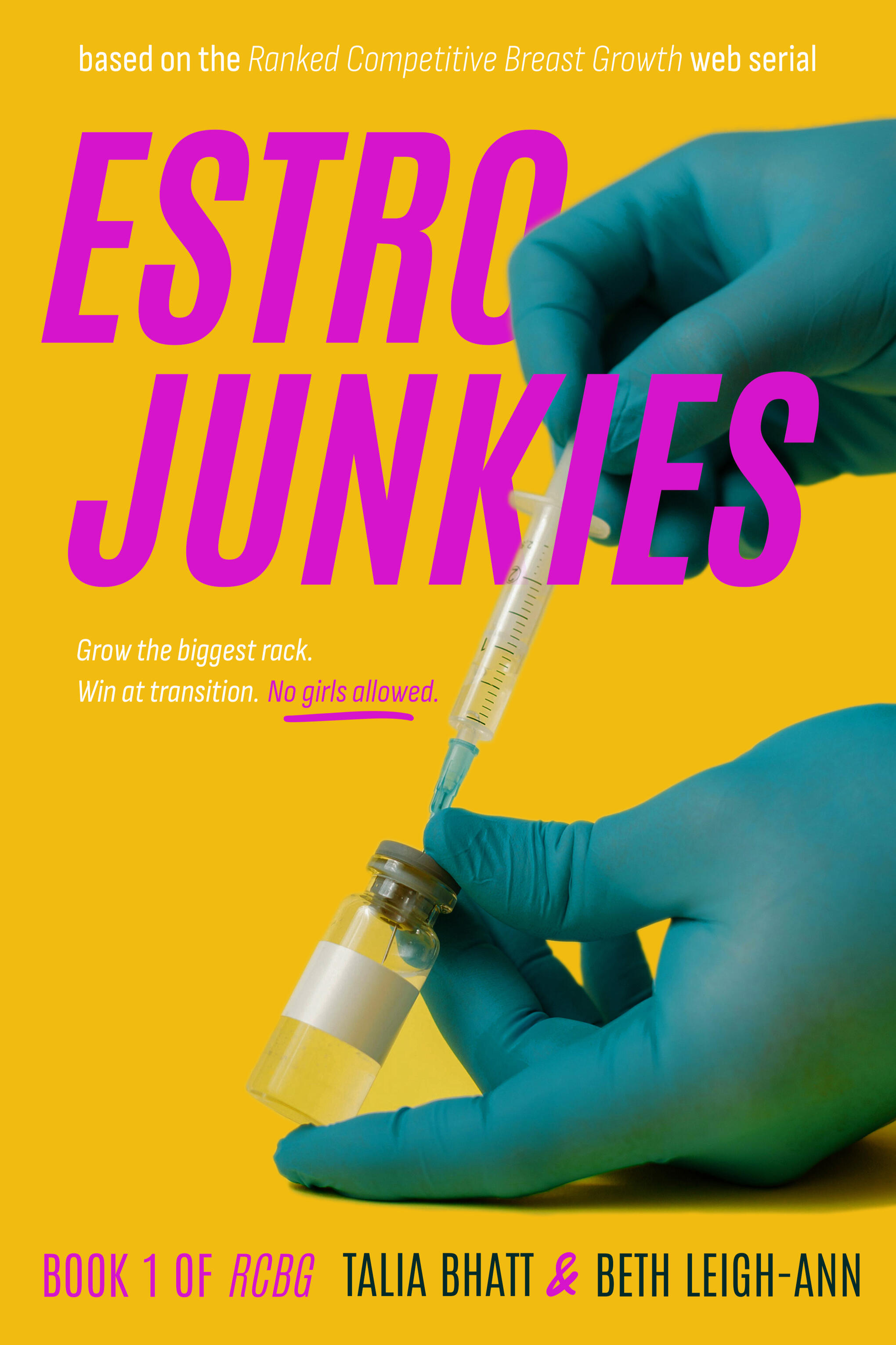
Book #1
Nicky’s never getting on oestrogen. She’s too late. The waiting lists are years long, and private clinics are shutting down. She’s rotting in the apartment she shares with her childhood friend Daniel, the insufferable twink Jeff, and Kyle with his helicopter mother and arranged marriage—and there’s no way out.Until Daniel knocks on her door with news of an underground online contest. It awards hormones and surgeries to anyone willing to grow the biggest breasts—so long as they claim they’re cis men, and no fellow competitor can prove otherwise. The prize for these men? A million dollars. For Nicky? Her salvation.Except not all’s as it seems. Daniel is actually Katherine, a trans woman terrified to come out—what if she loses her oldest and only friend? Jeff, hopelessly enamoured with Kyle, turned to the contest to make himself more attractive. And for Kyle, only a million-dollar victory could unshackle him from the life of an eldest desi son.As their lies and desires set the roommates on a collision course, the question remains: what kind of man would compete to take oestrogen? Answer carefully. Online, someone is always watching.
Coming Soon
Dulhaniyaa

Esha Arora is the last person anyone would've expected to acquiesce to an arranged marriage. Outspoken, opinionated and forward-thinking, she's made her thoughts on these archaic institutions clear. But to her family’s surprise and joy, when a good rishta for her hand comes along, Esha agrees to abruptly quit her MFA program in the States and returns to India to be wed.In the pursuit of extravagance, Esha’s mother arranges a dance instructor for her. Knowing the wedding isn’t actually about her wishes, Esha reluctantly agrees.That’s when Billu, a cyclone in a salwar and dancer extraordinaire, bursts into the monotony of Esha’s pre-wedding existence. Slowly, it dawns on Esha she isn’t nearly as resigned to her fate as she thought—but can she un-make a commitment so easily? Will she confess her feelings to Billu before the latter exits her life, or will she be consigned to her role of dulhaniyaa?A Bollywood-inspired desi lesbian romance, Dulhaniyaa is a story of class, queerness, and the struggle to accept your identity when it comes in conflict with your family and culture.
My feminist essays are available for free on Substack. For dissections of feminist literature in audio form, check out my podcast Cracked Ivory.
Brown / Trans / Les
How does one articulate a cohesive feminism in a culture whose most-spoken language lacks a word for 'misogyny'?
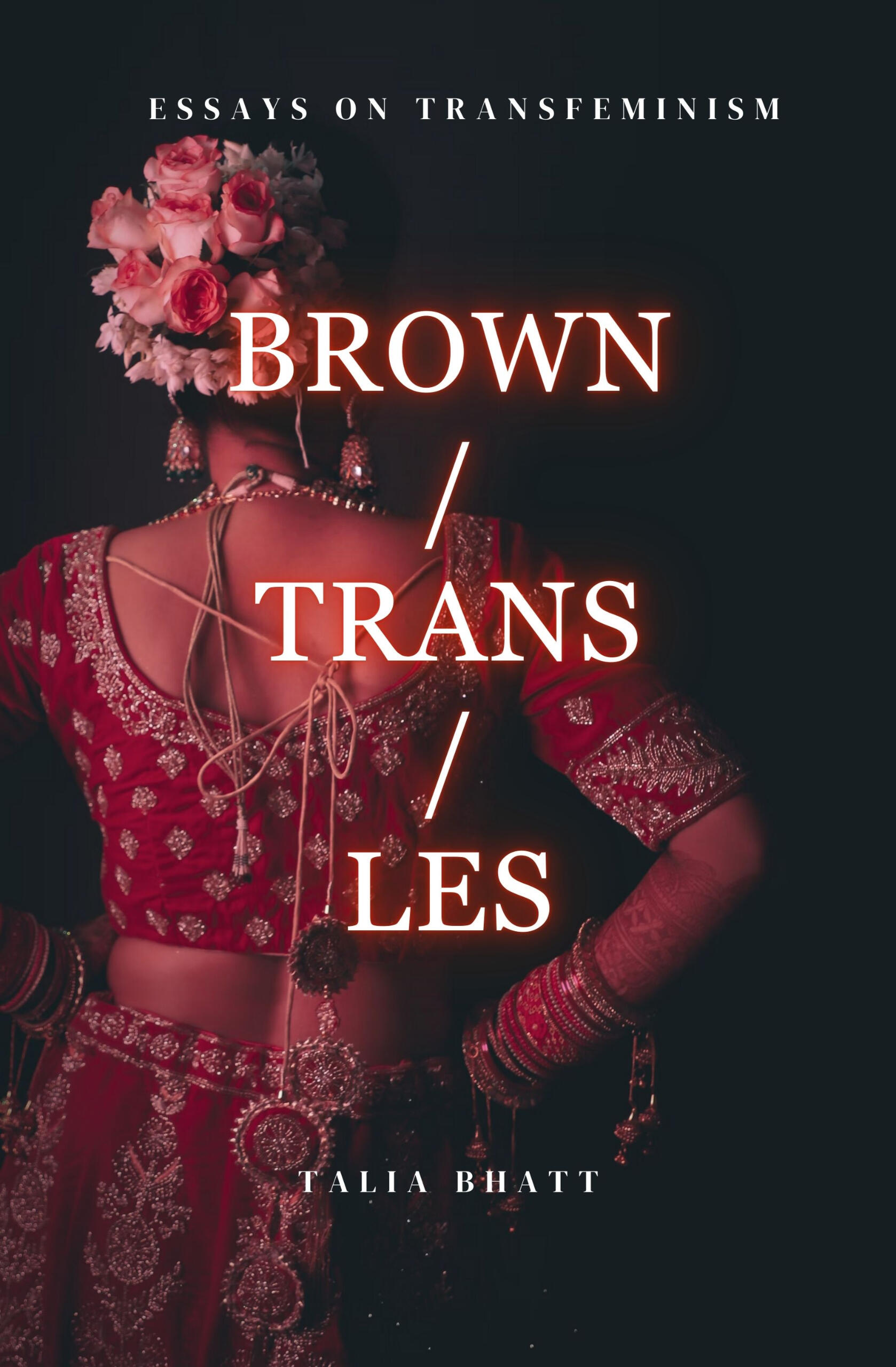
How does one articulate a cohesive feminism when feminists themselves insist on decentering women?In Trans/Rad/Fem, radical transfeminist Talia Bhatt attempted to provide a thorough, materialist framework for understanding the oppression of trans women particularly and all queer people generally as an indelible component of patriarchal misogyny. A key facet of that oppression is epistemicide, the totalizing erasure of knowledge, language, and history in order to prevent the marginalized from so much as being able to conceptualize the terms of their oppression.Transmisogyny is far from the only force that is animated by epistemic injustice, however. Few cultures illustrate the truth of that assertion better than the land of Bhatt's birth, a nation dogged by internal contradictions and fractious violence along the lines of caste, class, religion, nationality, and more, before even considering the matter of sex.In this text, Bhatt attempts to reckon with the questions that many feminists have long struggled to grapple with: Can feminism advocate for the plight of women without reinforcing the very category it seeks to interrogate? In a global hegemony with so many intersecting axes of dehumanization and marginalization, is feminism capable of advocating for the most vulnerable among us without rendering itself reactionary and absolute? Without holding the experiences of the most privileged above those of the least?The answer, she hopes, is "yes".
Trans / Rad / Fem
Can a synthesis of trans liberation and feminism be easily arrived at? This collection asserts that, as a matter of fact, we possessed the answer to that question decades ago.
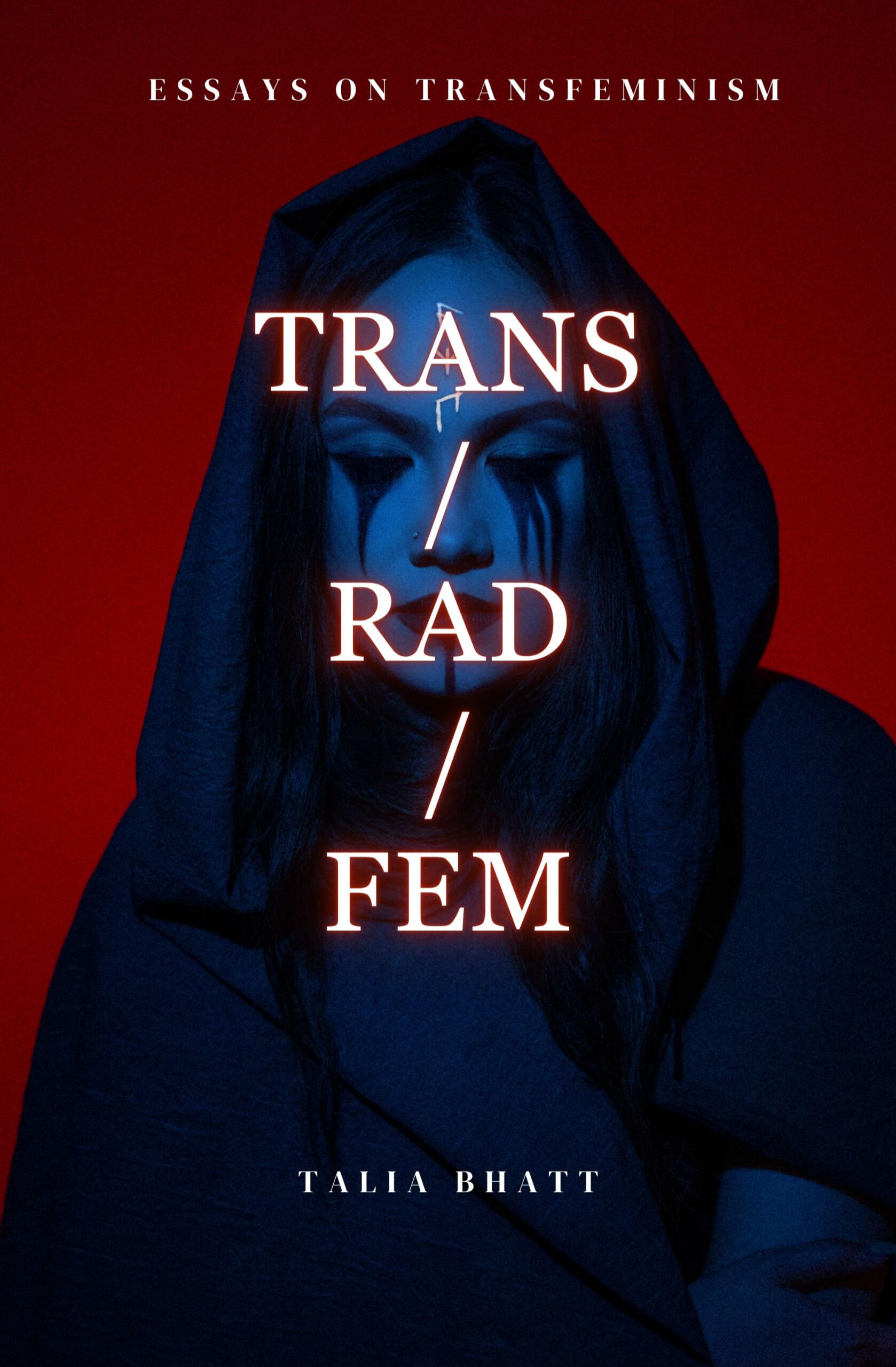
Second-Wave feminism is, today, nearly synonymous with ‘transphobia’. Any mention of this era or the movement of ‘radical feminism’ conjures images of feminists allying with right-wingers and the authoritarian state, providing legal justification for outlawing gender-affirming care and spreading deeply evil caricatures of trans women to rationalize their exclusion as feminist subjects. In the ensuing struggle to reconcile trans rights with feminism, the specter of the trans-exclusionary radical feminist has often reared its head in opposition. One may be tempted to conclude that the Second Wave, as a whole, has done irreparable harm to feminist, queer and trans politics, and must be discarded entirely.But is that truly the case?This series of essays aims to reconstruct and reintroduce the radical feminist framework that its misbegotten inheritors seem determined to forget and in doing so boldly makes the claim that transfeminism, far from being antagonistic to radical feminism, is in fact its direct descendant. It shows how a comprehensive social theory of transsexual oppression flows almost naturally from radical feminist precepts and dares to declare that a materialist, radical transfeminism is the way forward to seize the foundations of patriarchy at the root.